Overview
Middleware is one of Keq's most powerful features, allowing you to elegantly extend and customize HTTP request behavior. Keq adopts an onion model middleware architecture similar to Koa.
Why Middleware?
When using the native Fetch API, we often need various enhancements like automatic retry, timeout control, error handling, etc.
There are many such libraries on NPM, like fetch-retry and node-fetch-har,
which typically provide a wrap(fetch) style API. But this approach has two problems:
- Difficult to compose: Multiple features require nested wrapping like
wrapX(wrapY(wrapZ(fetch))), making code hard to maintain - Lack of flexibility: Difficult to configure different behaviors for different API routes
Some other HTTP client libraries provide interceptor mechanisms, but interceptors can usually only do simple pre/post-request processing. Complex requirements like SWR (Stale-While-Revalidate) caching become impractical.
Onion Model
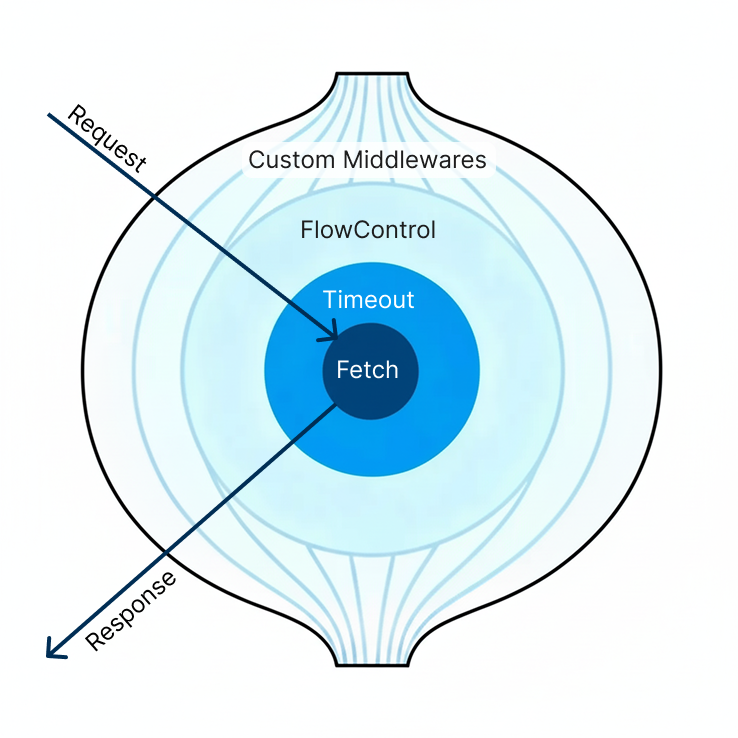
Keq's middleware uses the onion model: requests enter from the outermost middleware, passing inward layer by layer until the request is sent, then responses return from inside out — each middleware layer has the opportunity to process both the request and response.
Keq has 3 built-in core middleware layers (from outer to inner):
- flowControlMiddleware - Provides flow control functionality
- timeoutMiddleware - Provides request timeout control
- fetchMiddleware - Sends the actual request using Fetch API
Writing Middleware
Basic Concepts
A middleware is an async function that receives context and next as parameters, with the following type definition:
type KeqMiddleware = (context: KeqExecutionContext, next: () => Promise<void>) => Promise<void>Parameters:
- context - The request context containing all information like request parameters and response results (see Context Object)
- next - Function to call the next middleware layer
A simple middleware example:
import { KeqMiddleware } from "keq"

const myMiddleware: KeqMiddleware = async (context, next) => {
  // Modify request parameters here
  console.log("Before request")

  await next() // Call the next middleware layer

  // Process response here
  console.log("After request")
}
Applying Middleware
Use the .use() method to add middleware to a request instance:
import { request } from "keq"

request.use(myMiddleware)

// Chain multiple middleware
request
  .use(middleware1)
  .use(middleware2)
  .use(middleware3)
Example: Logging Middleware
Let's start with a simple example — writing middleware that records request duration:
import { request } from "keq"

request.use(async (context, next) => {
  const startTime = Date.now()
  console.log("Request started:", context.request.url.href)

  await next() // Execute the request

  const duration = Date.now() - startTime
  console.log("Request completed, duration:", duration, "ms")
})

await request.get("http://example.com/cats")
// Output:
// Request started: http://example.com/cats
// Request completed, duration: 234 ms
Reusable Middleware
Wrapping middleware in a function makes it reusable and configurable:
import { KeqMiddleware, request } from "keq"

// Create a logging middleware factory function
function logMiddleware(prefix: string): KeqMiddleware {
  return async (context, next) => {
    const startTime = Date.now()
    console.log(`${prefix} Request started:`, context.request.url.href)

    await next() // Execute the request

    const duration = Date.now() - startTime
    console.log(`${prefix} Request completed:`, context.response?.status, `Duration: ${duration}ms`)
  }
}

// Apply middleware
request
.use(logMiddleware("[API]"))// ✅ Good: single responsibility
function authMiddleware(token: string): KeqMiddleware { /* ... */ }
function logMiddleware(): KeqMiddleware { /* ... */ }
// ❌ Bad: mixed responsibilities
function megaMiddleware(): KeqMiddleware {
// Does both auth and logging
}Adding Custom Options
Middleware can add custom options through TypeScript module augmentation, allowing users to flexibly control behavior at call time.
Let's enhance the previous logging middleware by adding a silent option to control log output:
import { KeqMiddleware, request } from "keq"

// 1. Extend type definitions
declare module "keq" {
  interface KeqMiddlewareOptions<OP> {
    silent(value: boolean): Keq<OP>
  }
}

// 2. Create middleware with custom options support
function logMiddleware(prefix: string): KeqMiddleware {
  return async (context, next) => {
    // Read custom options
    const isSilent = context.options.silent || false

    if (!isSilent) {
      const startTime = Date.now()
      console.log(`${prefix} Request started:`, context.request.url.href)

      await next()

      const duration = Date.now() - startTime
      console.log(`${prefix} Request completed:`, context.response?.status, `Duration: ${duration}ms`)
    } else {
      await next()
    }
  }
}

request.use(logMiddleware("[API]"))

// 3. Normal usage outputs logs
await request.get("/cats")

// 4. Using the silent option suppresses logs
await request
  .get("/cats")
  .option("silent", true)
Routed Middleware
In the examples above, middleware applies to all requests. In real projects, different APIs may need different processing logic. Keq provides powerful routing to make middleware apply only to specific requests:
import { request } from "keq"

request
  .apply(logMiddleware("[EXAMPLE API]")).forRoutes({ host: "api.example.com" })
  .apply(logMiddleware("[ADMIN]")).forRoutes({ host: "admin.example.com" })
For detailed information on routing methods, see Routing Methods.
Creating Independent Instances
Use new KeqRequest() to create independent request instances — middleware and global state are completely isolated between different instances:
import { KeqRequest } from "keq"

const internalAPI = new KeqRequest({
  baseOrigin: "http://internal-api.company.com"
})

const externalAPI = new KeqRequest({
  baseOrigin: "https://api.example.com"
})

// Even with the same key, flow control queues are independent between instances
await Promise.all([
  internalAPI.get("/users").flowControl("serial", "api-key"),
  externalAPI.get("/data").flowControl("serial", "api-key"), // Independent from internalAPI, won't block
])
KeqRequest Constructor Options:
| Option | Description |
|---|---|
baseOrigin | Default request origin (browser defaults to window.location.origin, Node.js defaults to http://127.0.0.1) |
qs | Query parameter serialization options |
middlewares | Initial middleware array |
terminalMiddlewares | Custom terminal middleware (replaces the built-in flowControl/timeout/fetch pipeline) |
request object exported from keq is also a default KeqRequest instance.Sharing & Inheriting Middleware
When multiple API clients need to share some middleware (like auth, logging) while having their own independent configurations, you can use instance inheritance to avoid duplicate registration.
fork() - Derive a Child Instance
fork() derives a child instance from the current instance — the child automatically inherits all middleware from the parent:
import { request } from "keq"

// Parent instance adds global middleware
request.use(authMiddleware())
request.use(logMiddleware())

// Derive child instances that inherit authMiddleware and logMiddleware
const catAPI = request.fork({ baseOrigin: "https://cat-api.example.com" })
const dogAPI = request.fork({ baseOrigin: "https://dog-api.example.com" })

// Child instances can add their own middleware without affecting parent or siblings
catAPI.use(catCacheMiddleware())

await catAPI.get("/cats")   // Executes: authMiddleware → logMiddleware → catCacheMiddleware → fetch
await dogAPI.get("/dogs")   // Executes: authMiddleware → logMiddleware → fetch
inherit() / adopt() - Cross-Instance Middleware Reuse
fork() automatically shares middleware at derivation time. For independently created instances, inherit() and adopt() provide the same capability:
import { KeqRequest } from "keq"

const shared = new KeqRequest()
shared.use(authMiddleware())

const userAPI = new KeqRequest({ baseOrigin: "https://api.example.com" })

// These two are equivalent:
userAPI.inherit(shared)
// or
shared.adopt(userAPI)
After linking, middleware on shared applies to all requests from userAPI, while middleware registered on userAPI itself doesn't affect shared:
// Middleware added to shared later also applies to userAPI
shared.use(logMiddleware())

// userAPI's own middleware only takes effect within userAPI
userAPI.use(cacheMiddleware())

await userAPI.get("/me")
// Execution order: authMiddleware → logMiddleware → cacheMiddleware → fetch